

Last updated September 10, 2026
Full 25-point door and opener safety check with every visit - springs, cables, rollers, tracks, and your LiftMaster or Chamberlain opener included
You get a price before we start. It does not change when the truck arrives.
 Before
 After
After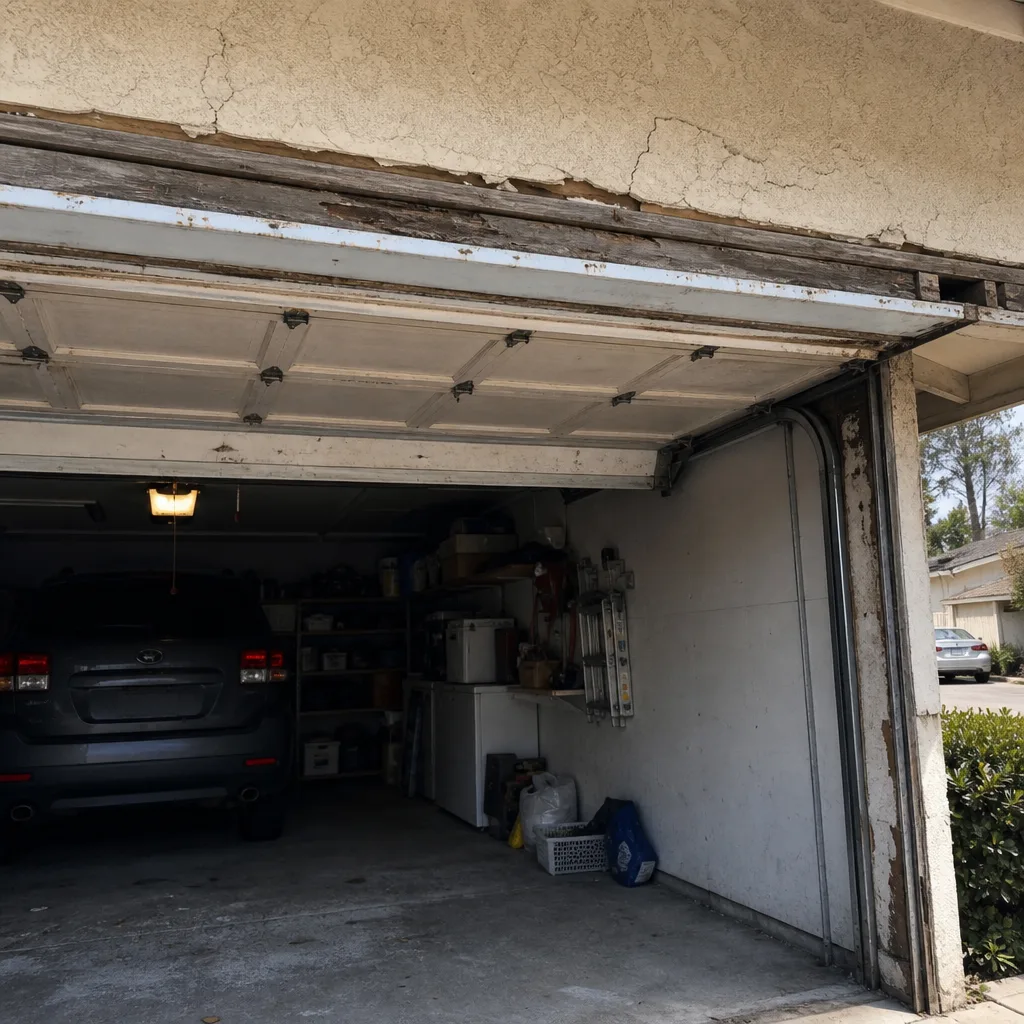 Before
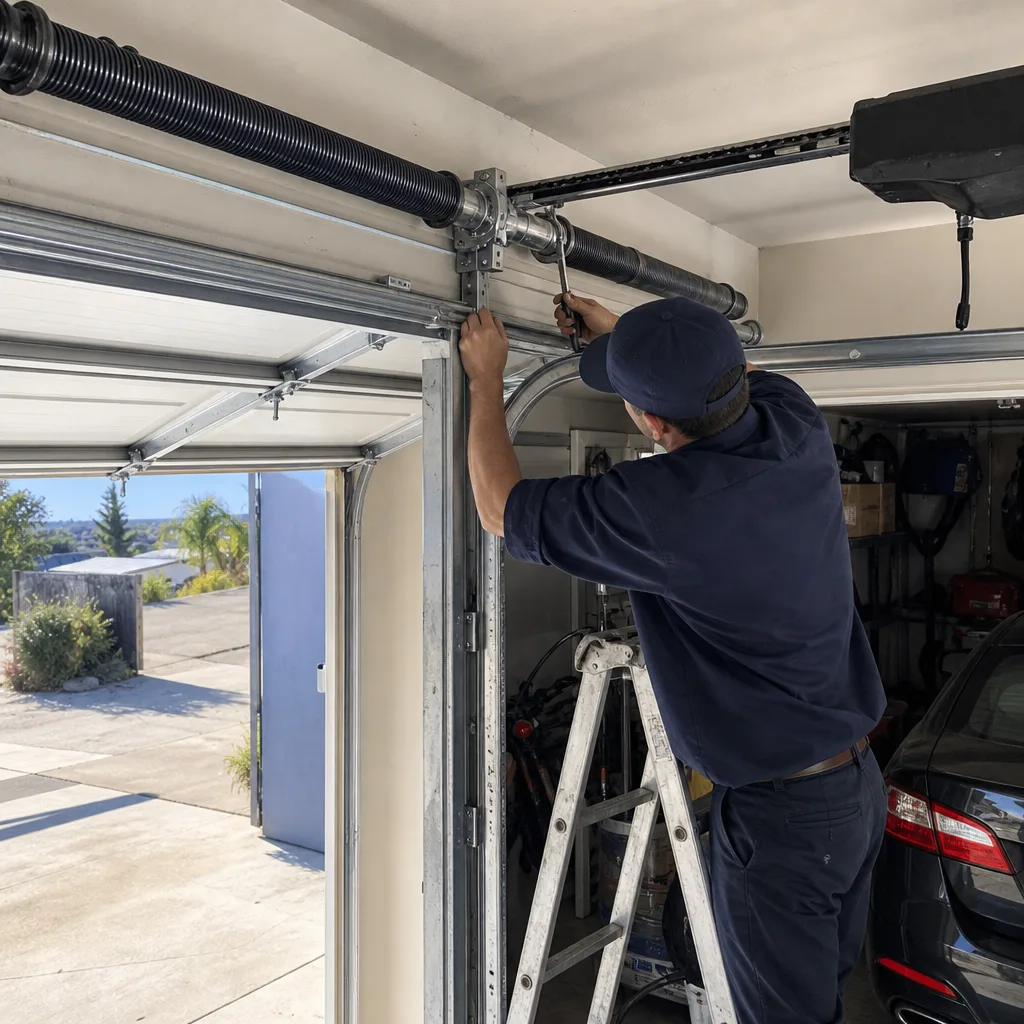 After
After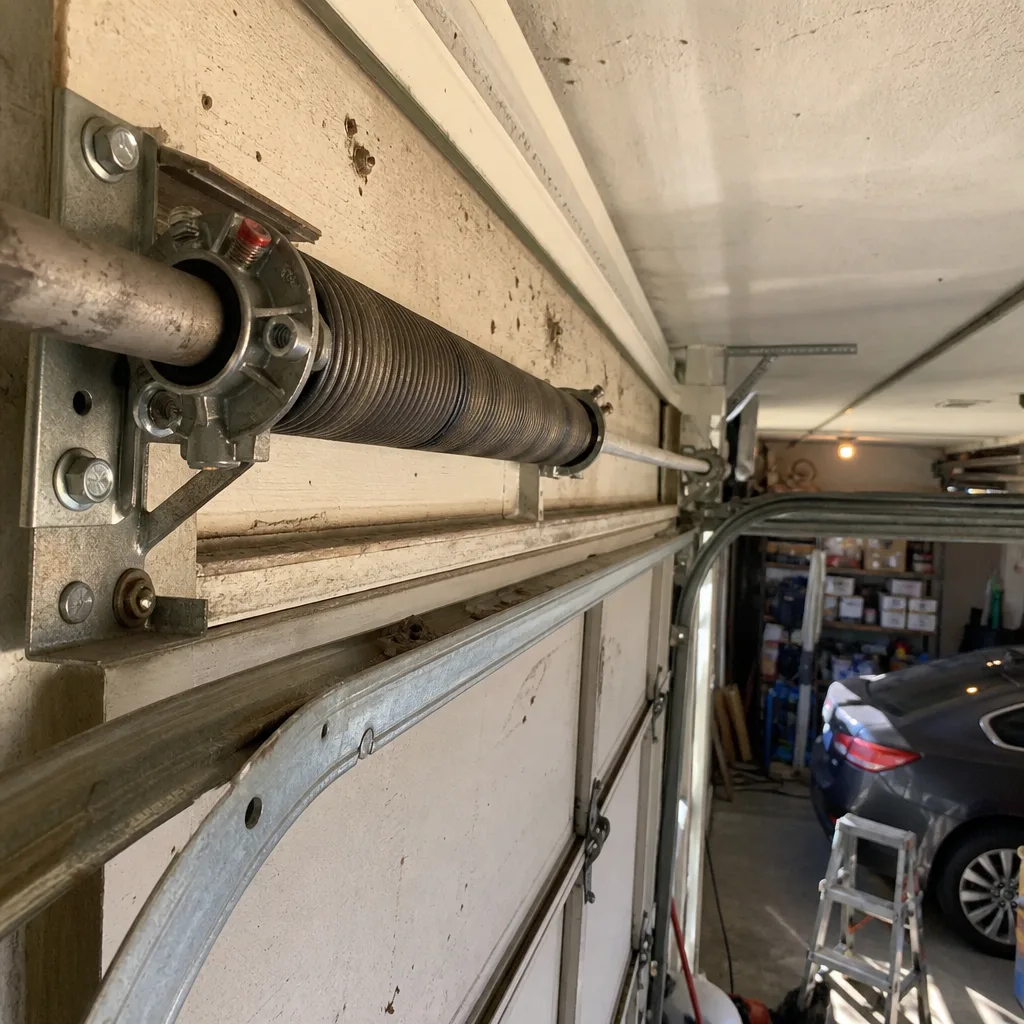 Before
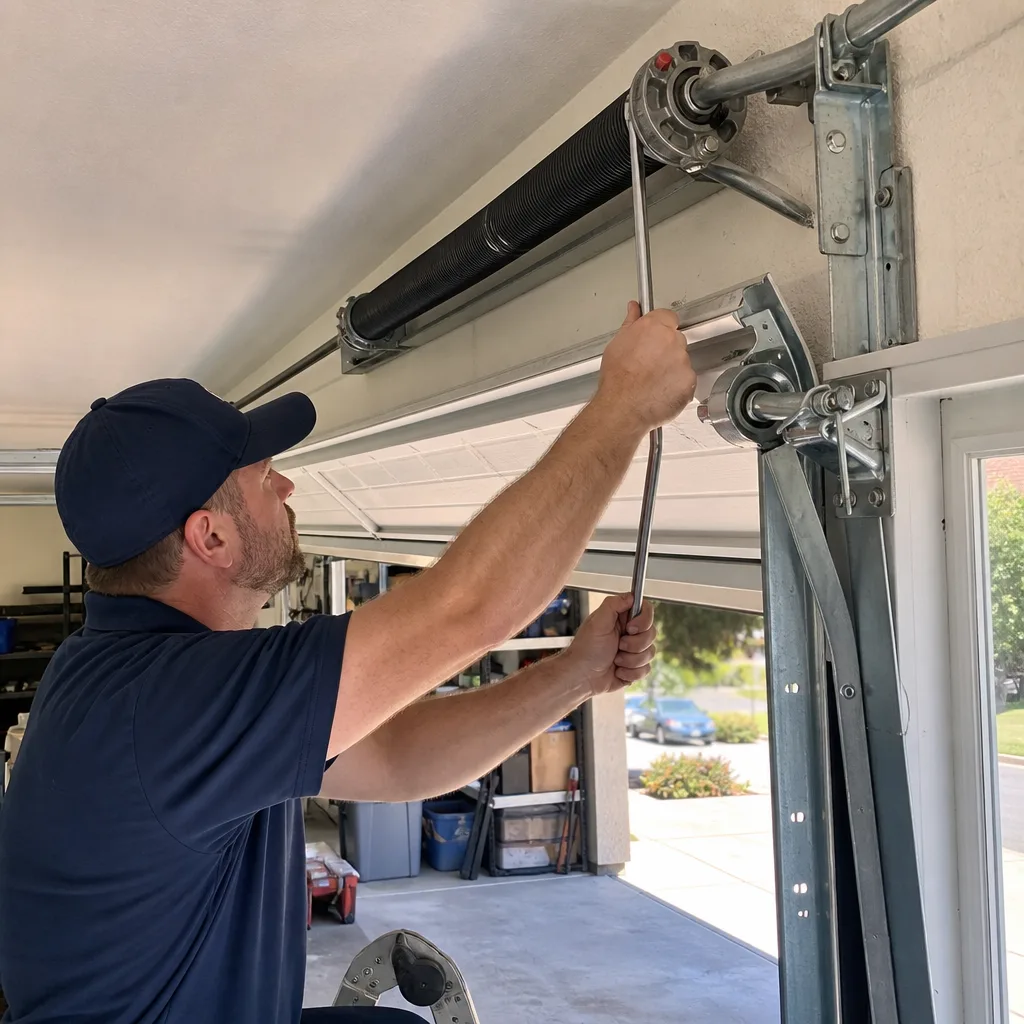 After
AfterGarage Door Warning Signs: A Valley Center Homeowner’s Reference Guide
A broken torsion spring doesn’t just snap out of nowhere at 6 a.m. on a Tuesday. It tells you it’s tired for weeks first. Most Valley Center homeowners just don’t know the language. This guide is the translation. You’ll learn which sounds mean “watch and wait” versus “call today,” how to spot a cable that’s six weeks from failing, and why that uneven gap under your door is telling you something important about spring tension. If your door has been talking to you lately, here’s what it’s been trying to say.
Quick Answer
Most garage door failures announce themselves days or weeks ahead with specific sounds, movements, and visual cues. A grinding noise usually means rollers or track wear. A popping noise usually means spring fatigue. A door that’s slow on one side means a cable or spring imbalance. Any of these three, left alone, leads to a door that won’t open at all, often with your car trapped inside. The fix is almost always cheaper and faster before the failure than after.
Table of Contents
- Grinding vs. Popping: Two Sounds That Both Mean Call Someone
- Why a Door That’s Slow on One Side Is Not an Opener Problem
- The Floor-Gap Test: What an Uneven Seal Tells You
- Rust Patterns: Cosmetic vs. Six Weeks From Failing
- When a Door Reverses Before It Closes: Three Causes
- The 60-Second Visual Inspection Every Homeowner Should Know
- What Valley Center Climate Does to Garage Doors
- What It Costs to Ignore the Warning Signs
- Common Mistakes to Avoid
- When to Call a Professional
- Frequently Asked Questions
Grinding vs. Popping: Two Sounds That Both Mean Call Someone
Your garage door makes two distinct sounds when something’s wrong, and confusing them leads to the wrong fix. In Valley Center, where detached garages sit far enough from the house that you might not hear the early stages, knowing the difference matters even more.
A grinding noise sounds like metal dragging across metal. It’s usually the rollers. Over time, the bearings inside rollers wear down, especially on doors that open and close four to six times a day. Once the bearing goes, the roller stops rolling and starts skidding along the track. You’ll hear it most clearly as the door passes the curved section of track near the top. The fix is usually straightforward: replace the rollers, often all of them at once since they wear at roughly the same rate. Nylon rollers with sealed bearings last longer than steel and run quieter on most doors, including Craftsman and Raynor models common in this area.
A popping noise is different. It’s sharp, like a gunshot muffled by a towel, and it comes from the torsion spring above the door. Springs don’t weaken evenly. As individual coils fatigue, they slip against each other and pop. You might hear it once when the door opens, or several times during a full cycle. This is not a sound to live with. A popping spring is a spring that’s already failing. When it lets go completely, you’ll know, because the door will either slam shut or refuse to lift, and the spring will be visibly split into two pieces.
How to Tell Them Apart in Ten Seconds
- Stand beside the door, not directly under it, and have someone operate the opener.
- If the sound follows the door’s movement along the track, it’s rollers or track.
- If the sound comes from overhead and happens in sharp bursts, it’s the spring.
- If you can’t tell, call a professional. Both issues get worse with every cycle.
We’ve replaced hundreds of popping springs in Valley Center garages. Every single homeowner said the same thing: “I heard that sound for a while, I just didn’t know what it meant.” Now you do.
Why a Door That’s Slow on One Side Is Not an Opener Problem
When a garage door lifts slower on the left side than the right, the natural assumption is that the opener is struggling. Most of the time, that’s wrong. The opener sits in the center and pulls from a single point. It can only do its job evenly if both sides of the door carry the same tension. When one side drags, the problem lives in the cables or the springs, not the motor.
Here’s what’s actually happening. Your door’s weight is countered by spring tension. On a torsion system, both springs wind and unwind together. When one spring loses tension or one cable stretches, that side of the door gets heavier. The opener keeps pulling, but now it’s fighting more resistance on one side. You’ll see the door tilt slightly as it rises, or hear the opener strain. Left alone, the imbalance grows. Every cycle adds wear to the opener’s gear and sprocket, which are not designed for uneven loads. Eventually one of three things happens: the cable snaps, the spring breaks, or the opener destroys its own gearbox trying to compensate. All three are more expensive than the imbalance would have been to fix.
If you notice uneven movement, stop using the door and call someone. This is a watch-today, call-today situation. The good news is that a skilled tech can usually re-balance the door in under an hour. The better news is that catching it before the failure saves you the cost of replacing whatever breaks next.
The Floor-Gap Test: What an Uneven Seal Tells You
Here’s a test you can do right now, no tools required. Close your garage door completely. Walk inside, look at the bottom edge of the door where it meets the concrete, and check the gap. Then look at it from outside at dawn or dusk, when light shows through any opening. A door that seals flat against the ground means the springs, cables, and track are working together. A door with a gap on one side means something is out of balance.
The floor-gap test works because your garage door is a single rigid panel system. If one corner sits higher than the other, that corner’s cable is carrying less tension than its partner. The causes are usually one of three: a spring that’s losing tension, a cable that’s stretched, or a track that’s drifted out of alignment. All three are progressive. The gap you measure today will be bigger next month, then bigger the month after, until the door jams or the cable comes off entirely.
What to Check When You Find a Gap
- Run your hand along the bottom seal. Is it compressed evenly, or is one side barely touching?
- Look at the cables on both sides of the door. Is one visibly looser when the door is down?
- Check the track brackets. Are all the bolts still tight against the wall?
- Measure the gap with a tape measure, wait two weeks, and measure again. If it’s growing, the imbalance is active.
In Valley Center, where many homes sit on expansive soil that shifts with wet winters and dry summers, track brackets loosen more often than in coastal areas. The ground moves. The walls move. The track that was plumb in July might be leaning by January. Add this to your Seasonal Garage Door Care for Valley Center: Year-Round Homeowner’s Guide checks, same as you’d check your gutters.
If you find a gap and you’re not sure whether it’s soil movement or a spring issue, that’s exactly the kind of thing we look at during a free estimate. You can read more about what’s involved on our Garage Door Repair in Valley Center page.
Rust Patterns: Cosmetic vs. Six Weeks From Failing
Southern California isn’t known for rust, but Valley Center sits close enough to the coast that marine air pushes inland on summer mornings. It’s not the constant salt spray of Oceanside, but it’s enough. Metal parts in your garage age faster out here than they do in Escondido or Ramona, especially if your garage is uninsulated and open to morning fog.
The trick is knowing which rust is harmless and which rust is a countdown.
Cosmetic rust shows up as light surface discoloration on the door panels, especially along the bottom edge where moisture collects. It’s ugly, but it doesn’t affect function. You can sand it, prime it, and repaint, or leave it alone. The door will still open and close safely.
Structural rust is different. It appears on the springs, the cables, and the spring anchor brackets, and it’s never just surface-level. When a torsion spring rusts, the metal oxidizes unevenly. Each rust pit becomes a stress point. Every time the spring winds and unwinds, which is every time you open or close the door, those stress points flex. At some point, one of them cracks. The spring snaps. A spring that’s rusted on the outside is a spring that’s rusted on the inside, and it will fail sooner than a clean one.
Here’s a rule that’s served Valley Center homeowners well: if the rust is on a part that moves under tension, it’s a call-today situation. Springs, cables, cable drums, and bottom brackets all qualify. If the rust is on a stationary panel, it’s cosmetic. Watch it, but don’t lose sleep over it.
One more thing worth knowing: a rusted cable is not a cable you should try to replace yourself. Those cables are under the same tension as the springs. When one lets go, it moves fast and hurts anything in its path. Same goes for the springs themselves. A door is 200 pounds riding on two springs. Respect it.
When a Door Reverses Before It Closes: Three Causes
Modern garage door openers have a safety mechanism that reverses the door if it meets resistance on the way down. When your door reverses halfway or inches before the ground, that mechanism is doing its job. Something is triggering it. The question is what. There are three possibilities, and one of them you can fix yourself.
Cause one: an obstruction or a misaligned sensor. This is the one you can handle. Something is blocking the infrared beam near the bottom of the door opening. Check for leaves, spider webs, a rake that fell over, or dirt on the sensor lens. Clean the lens with a soft cloth and make sure both sensors are pointing at each other. On a Chamberlain or LiftMaster opener, the sensor lights will glow steady when aligned and blink when not. If this fixes it, you’re done.
Cause two: the close-force setting is too low. Opener settings drift over time. If the close force is set too low, the opener thinks the floor is an obstruction and reverses. This is a simple adjustment, but it requires you to read your opener’s manual and follow the steps exactly. Too much force is dangerous. Too little force means the door never closes. If you’re not comfortable, leave it to someone who adjusts these every day.
Cause three: the door itself is dragging. This is the one that sends people down the wrong path. When the rollers are worn, the track is bent, or the spring is losing tension, the door requires more effort to close than it did when the opener was set. The opener senses the extra effort as an obstruction and reverses. The opener isn’t broken. It’s telling you the door is. Fix the door, and the reversing stops.
If you’ve cleaned the sensors and the door still reverses, the problem lives somewhere in the mechanical system. That’s a licensed-tech-with-a-torque-wrench situation, not a DIY afternoon.
The 60-Second Visual Inspection Every Homeowner Should Know
You don’t need to be a garage door tech to catch most failures early. You need one minute, decent lighting, and the willingness to actually look. Here’s the step-by-step inspection we recommend to every homeowner in Valley Center, whether your door is two years old or twenty, with How to Hire a Garage Door Contractor in Valley Center: A Step-by-Step Guide if you need professional help.
The Inspection
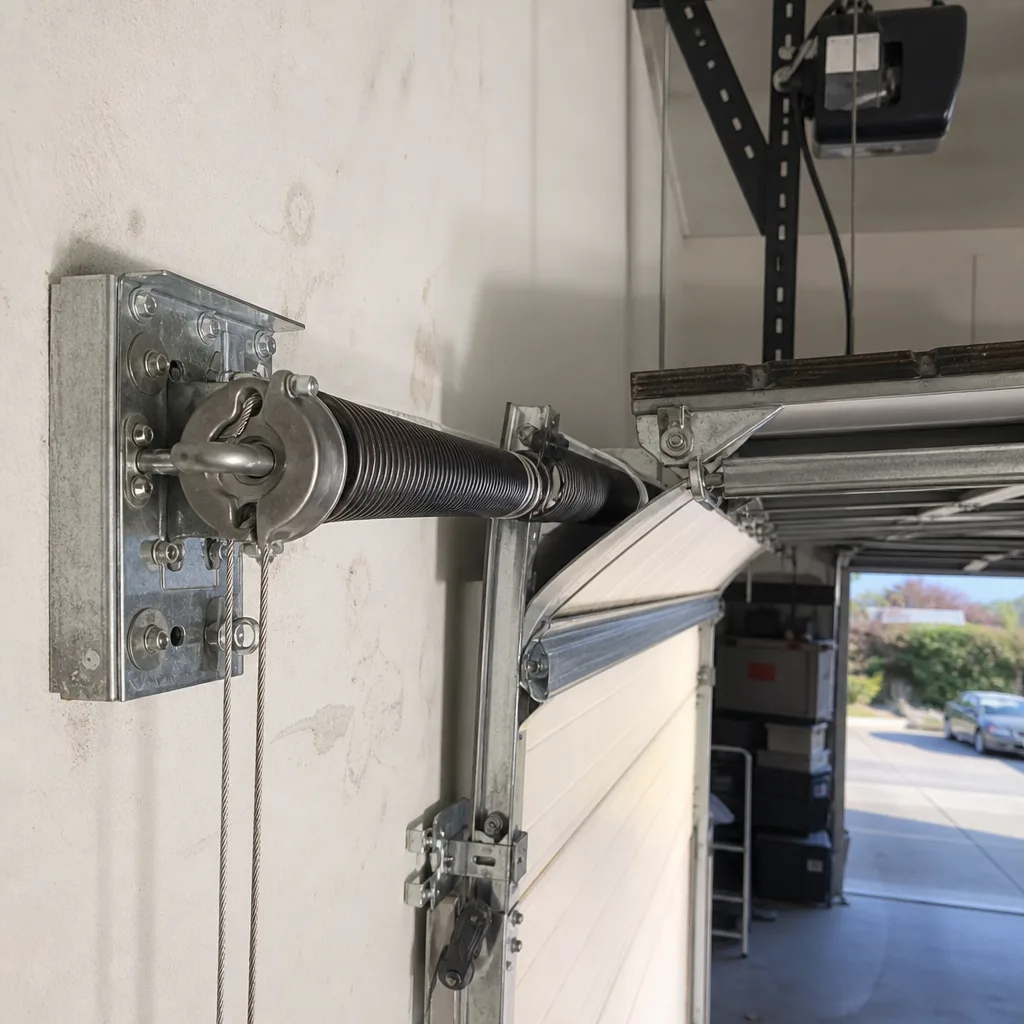
- Look at the springs first. With the door closed, stand inside the garage and look up. You should see one or two torsion springs mounted on a bar above the door. Look for a gap in the spring, which means it’s broken. Look for rust. Look for uneven spacing between coils. Any of these means the spring is at the end of its service life.
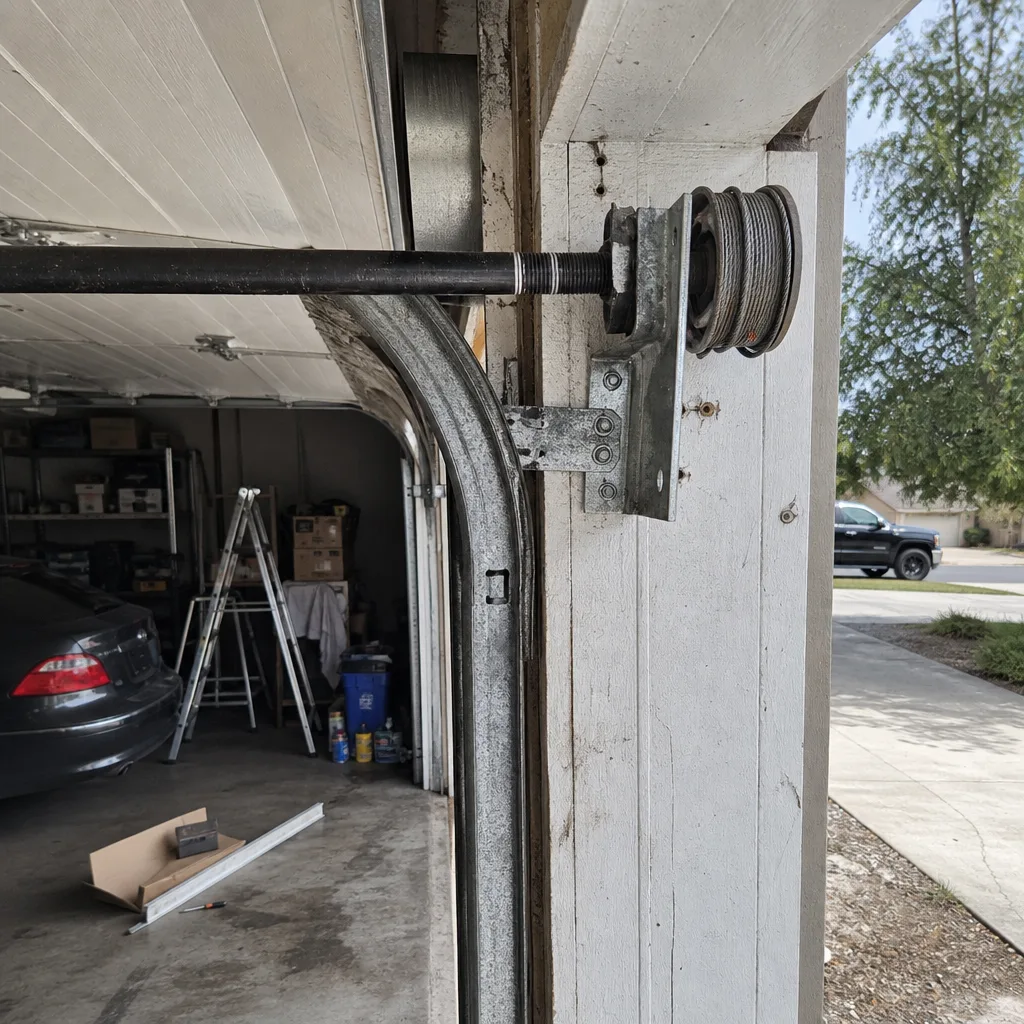
- Look at the cables. The cables run from the bottom brackets up to the drums at each end of the spring bar. Look for fraying. A cable with broken strands looks fuzzy, like a rope that’s coming apart. That cable is days or weeks from snapping.
- Check the rollers. Run the door up halfway and inspect each roller. Worn rollers have flat spots or wobble when the door moves. Nylon rollers with cracks, or steel rollers with missing bearings, need replacement.
- Look for track wear. Run your finger along the inside edge of the track where the rollers sit. It should be smooth. Deep scratches or gouges mean the rollers have been grinding against metal, and the track may need work or replacement.
- Test the balance. Pull the red emergency release handle with the door closed. Then try to lift the door manually. A properly balanced door should lift smoothly with one hand and stay in place when you let go at the halfway point. If it’s heavy, or if it slams when you let go, the springs are not doing their job.
- Listen. Operate the door once and listen. Grinding means rollers. Popping means springs. Rattling means loose bolts somewhere, usually in the track brackets or hinge plates.
Run this inspection twice a year. Spring and fall. It takes a minute, and it catches problems at the stage where a $150 repair prevents a $900 emergency.
What Valley Center Climate Does to Garage Doors
Every region has its own garage door problems, and Valley Center is no exception. Understanding the local conditions helps you know what to watch for, because the door on a garage off Cole Grade Road ages differently than the same door in a garage in Carlsbad.
Three things define our area’s effect on garage doors. First, the summer heat. Valley Center regularly hits the 90s and occasionally the 100s between June and September. Metal expands in heat, contracts when it cools, and repeats that cycle daily. Over years, this thermal cycling is what moves track bolts loose and warps cheap steel panels. If your garage door faces west, it’s getting hammered with direct afternoon sun. The panels absorb heat, and the paint is the first casualty. You’ll see fading and micro-cracking long before the metal gives out.
Second, the inland morning fog and winter moisture. We’re far enough east that we don’t get the heavy marine layer every day, but we get enough. Uninsulated garages in Valley Center collect condensation on metal parts, and that means rust on springs and cables, particularly from November through March. The rust patterns section of this guide covers what to do about it.
Third, the soil. Expansive clay soil under much of Valley Center swells in wet winters and shrinks in dry summers. Garage slabs don’t usually crack from this, but walls shift enough to knock track brackets out of alignment. If your door suddenly starts binding or sticking in February, after three months of rain, check the track alignment before you assume it’s a spring issue. It often isn’t.
This is the reason we recommend a Garage Door Installation in Valley Center consider local conditions when choosing doors. A door that works beautifully in a climate-controlled showroom in Los Angeles might fight you out here in the heat and the fog. Local experience matters more than most homeowners realize.
What It Costs to Ignore the Warning Signs
Garage doors fail on a predictable cost curve. The longer you wait, the more zeroes appear on the invoice. Here’s the pattern we see in Valley Center, over and over.
Stage one: the early warning. A grinding roller, a popping spring, a small imbalance. At this stage, the fix is usually under $200. Maybe you need a few rollers replaced, or a cable adjusted, or track bolts tightened. Most people never notice this stage, because the door still opens and closes.
Stage two: the visible problem. The door is slow. The gap is obvious. The noise is loud. At this stage, the repair might run $200 to $500, depending on what’s worn. The door still works, but you know something’s wrong. This is where most people call, and it’s a fine time to call, because stage three is coming.
Stage three: the failure. A spring snaps. A cable breaks. The door comes off its track. The opener burns out its gearbox fighting an unbalanced door. Now you’re not replacing a roller or adjusting a spring. You’re replacing the entire counterbalance system, possibly the track, possibly the opener. This is the $700 to $1,500 job that could have been a $180 job six months earlier.
The cost of ignoring a warning sign isn’t just the difference between $180 and $1,200. It’s also the inconvenience of a car trapped in the garage at nine at night, the security risk of a door that won’t close, and the safety risk of a 200-pound panel that’s no longer under control. If your door has been telling you something, listen now. It’s cheaper today than it will be next month.
And when you do call, get a price before the truck shows up. We quote on the phone and hold the number when we arrive. That’s how Otto’s Garage Door home has operated since the first job in 2004, and it’s not changing.
Common Mistakes to Avoid
- Lubricating a popping spring. Lubrication fixes squeaks. It does nothing for a spring that’s popping from fatigue. You’re treating the symptom while the structural problem grows. The spring is still failing, just quieter.
- Replacing the opener batteries when the door is slow on one side. Batteries affect remote range, not door speed. If your remote opens the door from the driveway but the door moves unevenly, the batteries are fine. The balance isn’t.
- Ignoring the floor gap because the door still works. That gap is your most reliable early warning system. It’s free to check, it takes seconds, and it tells you about spring tension, cable wear, and track alignment all at once. Ignore it and you’ll hear about it later, usually from a broken spring.
- Using the door after a cable frays. Frayed cables are under hundred-pound loads. When they snap, they whip. People have been injured standing too close. If you see fraying, stop using the door and call someone the same day.
- Fixing an opener reverse issue by forcing the door closed. Holding the wall button down to override the safety reverse defeats the thing that’s protecting your kids, your pets, and your car. The reverse is a signal about the door’s mechanics. Read the signal don’t mute it.
- Waiting to call because the problem is intermittent. Garage door problems don’t fix themselves. An intermittent problem is a problem that’s going to become permanent at the worst possible moment, like a spring that pops only sometimes, right up until it doesn’t pop, it breaks.
- Assuming a newer door can’t have spring problems. A standard torsion spring lasts 10,000 to 15,000 cycles. A door installed in 2018 and cycled four times a day could be at the end of its service life by 2026. Age of the door is irrelevant. Cycle count is everything.
When to Call a Professional
Some garage door work is safe to do yourself: cleaning sensors, tightening visible bolts, even replacing a bottom seal. Everything involving spring tension is not. If you see or hear any of the following, call a professional before you operate the door again:
- A broken or visibly rusted torsion spring
- A frayed or loose cable
- A door that’s fallen off its track
- An opener that reverses for no reason you can identify
- A door that’s heavy to lift manually or won’t stay up at the halfway point
- Any popping sound from the spring area
Otto’s Garage Door offers free estimates in Valley Center. We’ll answer in person, quote the job over the phone, and hold that price when we arrive. Call (760) 906-8603. We’ve been doing this since 2004, and we’ll be here when your door needs us next.
Frequently Asked Questions
Spring replacement in Valley Center typically runs $180 to $340 for a standard torsion spring, including the part and labor. The exact price depends on the door’s weight and spring size. Some doors have two springs, which changes the total. Call (760) 906-8603 for a quote before any work starts, and you’ll know the number before the truck shows up. Our estimate is free, and the price we quote on the phone is the price on the invoice.
Yes. Most spring replacements, cable repairs, and roller replacements are same-day jobs. We answer the phone around the clock, including nine at night when a spring lets go and your car is sealed inside. Otto quotes the job on that call and holds the number when he arrives. Call (760) 906-8603 and a live person answers, not a phone tree.
No. We quote the job over the phone and hold that number when we arrive. If the problem turns out to be something different than you described, we’ll show you, explain it, and give you a new number before any work is done. Nothing gets added to the invoice without your explicit approval first. That policy has been in place since 2004, and it’s written on every job.
Yes. Our trucks carry springs in common sizes, cables, rollers, hinges, and opener parts for major brands including LiftMaster, Chamberlain, and Genie. The part you need is usually in the truck, which is why most repairs are completed in a single visit. If a special-order part is required, we’ll tell you before we leave and schedule the follow-up at a time that works for you.
Spring fatigue and failure. The heat, the winter moisture, and the high cycle counts on a door used four to six times a day all work against the springs. Valley Center homeowners also deal with track alignment issues from expansive soil movement, which is less common closer to the coast. If you’re hearing popping sounds, get it checked before it becomes a full failure.
Some things are fine: cleaning sensors, tightening track bolts, replacing a bottom seal. Torsion springs and cables are not. Those parts are under enough tension to cause serious injury if they release. A door is 200 pounds riding on two springs. Respect it. For anything involving spring tension, cables, or a door off its track, call a licensed professional, and check our more guides & resources for additional help. Otto’s Garage Door offers free estimates in Valley Center, and Otto or one of his crew will show up ready to fix it right.
The Bottom Line
Your garage door has been talking to you. The grinding, the popping, the uneven gap, the slow lift on one side: these are not normal aging. They’re specific warnings with specific causes, and each one is cheaper to fix today than it will be next month or next season. Run the 60-second inspection twice a year. Learn the difference between a grinding roller and a popping spring. Pay attention to that floor gap. And when you need a second opinion or a repair, call Otto’s Garage Door Opener in Valley Center or reach the shop directly at (760) 906-8603. A live person answers, the quote is free, and the price you’re quoted is the price you pay.
Written by Otto Reinhardt, Owner at Otto’s Garage Door, serving Valley Center since 2004.